
Hardware Overview
The Anselm cluster consists of 209 computational nodes named cn[1-209] of which 180 are regular compute nodes, 23 are GPU Kepler K20 accelerated nodes, 4 are MIC Xeon Phi 5110P accelerated nodes, and 2 are fat nodes. Each node is a powerful x86-64 computer, equipped with 16 cores (two eight-core Intel Sandy Bridge processors), at least 64 GB of RAM, and a local hard drive. User access to the Anselm cluster is provided by two login nodes login[1,2]. The nodes are interlinked through high speed InfiniBand and Ethernet networks. All nodes share a 320 TB /home disk for storage of user files. The 146 TB shared /scratch storage is available for scratch data.
The Fat nodes are equipped with a large amount (512 GB) of memory. Virtualization infrastructure provides resources to run long-term servers and services in virtual mode. Fat nodes and virtual servers may access 45 TB of dedicated block storage. Accelerated nodes, fat nodes, and virtualization infrastructure are available upon request from a PI.
Schematic representation of the Anselm cluster. Each box represents a node (computer) or storage capacity:
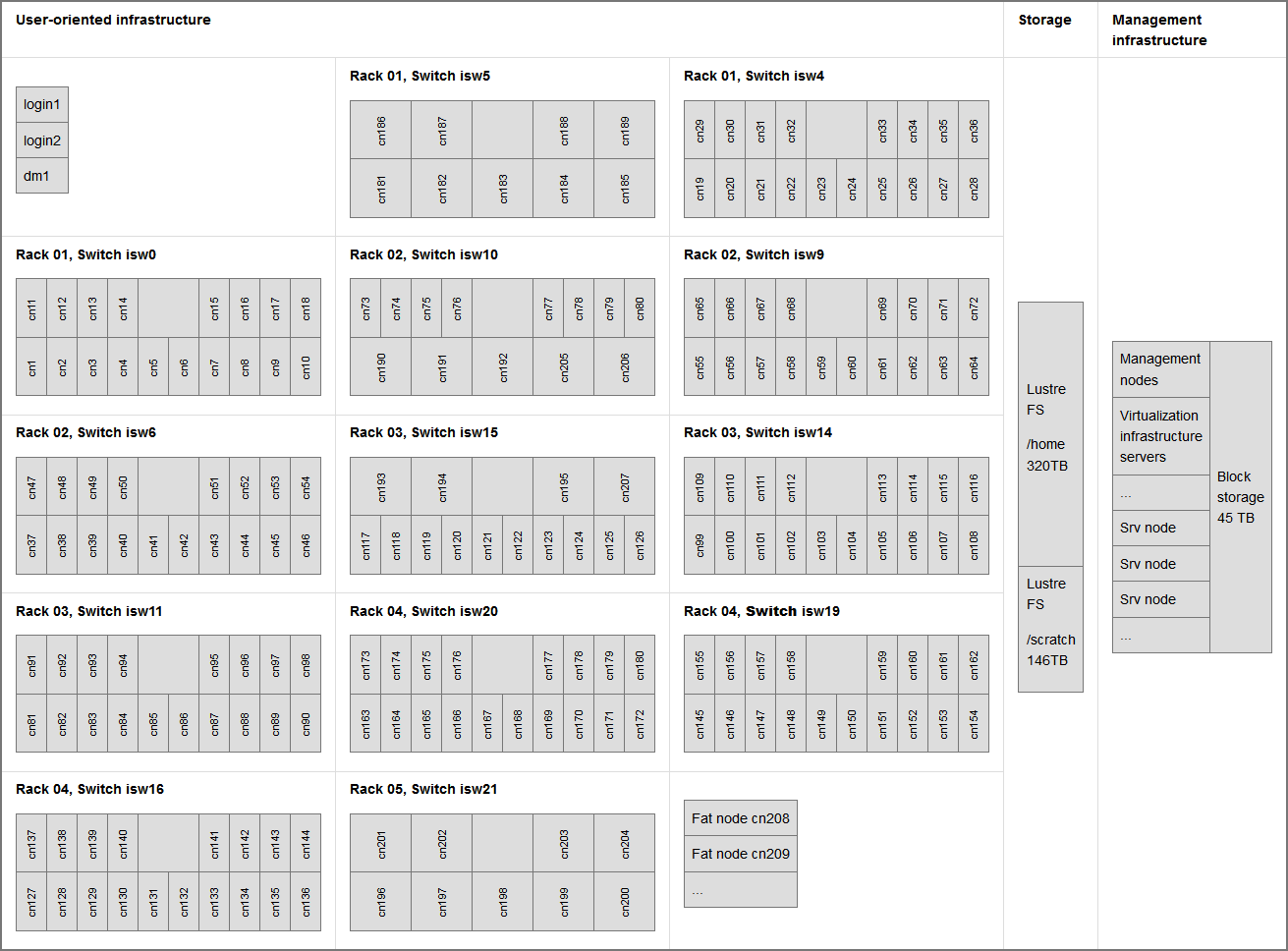
The cluster compute nodes cn[1-207] are organized within 13 chassis.
There are four types of compute nodes:
- 180 compute nodes without an accelerator
- 23 compute nodes with a GPU accelerator - an NVIDIA Tesla Kepler K20m
- 4 compute nodes with a MIC accelerator - an Intel Xeon Phi 5110P
- 2 fat nodes - equipped with 512 GB of RAM and two 100 GB SSD drives
GPU and accelerated nodes are available upon request, see the Resources Allocation Policy.
All of these nodes are interconnected through fast InfiniBand and Ethernet networks. More about the Network. Every chassis provides an InfiniBand switch, marked isw, connecting all nodes in the chassis, as well as connecting the chassis to the upper level switches.
All of the nodes share a 360 TB /home disk for storage of user files. The 146 TB shared /scratch storage is available for scratch data. These file systems are provided by the Lustre parallel file system. There is also local disk storage available on all compute nodes in /lscratch. More about Storage.
User access to the Anselm cluster is provided by two login nodes login1, login2, and data mover node dm1. More about accessing the cluster.
The parameters are summarized in the following tables:
| In general | |
|---|---|
| Primary purpose | High Performance Computing |
| Architecture of compute nodes | x86-64 |
| Operating system | Linux (CentOS) |
| Compute nodes | |
| Total | 209 |
| Processor cores | 16 (2 x 8 cores) |
| RAM | min. 64 GB, min. 4 GB per core |
| Local disk drive | yes - usually 500 GB |
| Compute network | InfiniBand QDR, fully non-blocking, fat-tree |
| w/o accelerator | 180, cn[1-180] |
| GPU accelerated | 23, cn[181-203] |
| MIC accelerated | 4, cn[204-207] |
| Fat compute nodes | 2, cn[208-209] |
| In total | |
| Total theoretical peak performance (Rpeak) | 94 TFLOP/s |
| Total max. LINPACK performance (Rmax) | 73 TFLOP/s |
| Total amount of RAM | 15.136 TB |
| Node | Processor | Memory | Accelerator |
|---|---|---|---|
| w/o accelerator | 2 x Intel Sandy Bridge E5-2665, 2.4 GHz | 64 GB | - |
| GPU accelerated | 2 x Intel Sandy Bridge E5-2470, 2.3 GHz | 96 GB | NVIDIA Kepler K20m |
| MIC accelerated | 2 x Intel Sandy Bridge E5-2470, 2.3 GHz | 96 GB | Intel Xeon Phi 5110P |
| Fat compute node | 2 x Intel Sandy Bridge E5-2665, 2.4 GHz | 512 GB | - |
For more details, refer to Compute nodes, Storage, and Network.